

Take action
Reuse glass. Give it another role.

KEY TAKEAWAYS
- Clean, undamaged bottles and jars can find plenty of practical uses around the home.
- Glass is highly inert, making it well suited to storing many everyday products.
- Reusing a jar for storage is different from using it for home canning, which requires suitable jars and tested methods.
- And when you no longer have a use for it, glass packaging can go back into the recycling loop.
Finished with a bottle or jar? It may still be useful before it heads to the recycling bin.
Glass is highly inert, which means it has very little interaction with what it contains. And with so many shapes, sizes and colours around the home, empty glass packaging offers plenty of possibilities for storage, decoration and creative projects.
Source: Dieter Schrenk, Literature Report on Food Packaging Materials and Their Potential Impact on Human Health, 2014 – Read the scientific report
Is all glass reusable?
Not every glass object is designed for the same job.
Bottles and jars can often be repurposed for simple household uses, provided they are clean and in good condition. Specialist glass products, such as heat resistant or tempered glass, have different properties and may not be suitable for the same uses.
It is also worth thinking about what you plan to put inside. A jar used to organise buttons asks very different things of the glass than one used for heat processing food.
Start with a clean slate

WASH
Remove any remaining food or product, then wash the container thoroughly with warm water and detergent. Labels can usually be loosened by soaking the jar or bottle before gently scraping away any residue.
Check the glass while you clean it. If you find cracks or chips, particularly around the rim, choose another container.
Source: National Center for Home Food Preservation, Do I need to pre-sterilize my jars before canning? – Read the guidance on cleaning and inspecting jars

MATCH IT TO THE JOB
For dry storage, crafts or decoration, a clean and fully dry container may be all you need.
Food preservation is different. Sterilising jars is only one part of a safe home canning process, and whether it is needed depends on the recipe and processing time. Always follow tested preservation guidance rather than simply boiling any empty jar before filling it.
Source: National Center for Home Food Preservation, Sterilization of Empty Jars – Read the home canning guidance
Three ways to reuse glass
Pasta, rice, spices, tea bags, nuts or baking ingredients. A row of clear jars makes it easy to see what you have and can bring a little order to kitchen shelves.
And it does not stop at the pantry. Glass jars can hold stationery, sewing supplies, small toys, bathroom essentials and all those little things that never seem to have a home.
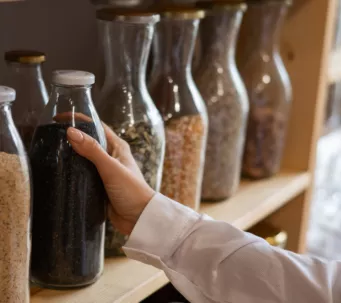
PANTRY
Give everyday ingredients a clear place of their own with clean, reused glass jars.
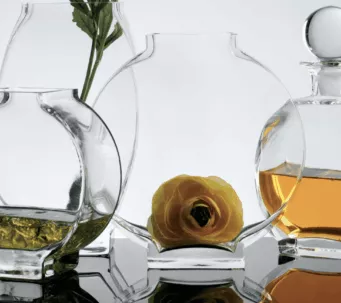
PLANTS
Turn a bottle into a vase or use a jar to watch new roots grow.
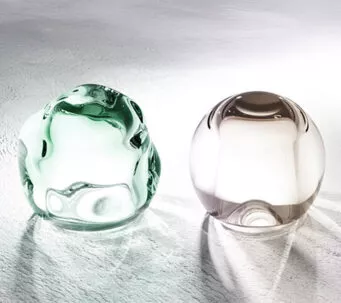
DECORATION
A little colour or light can turn empty packaging into something worth keeping.
Reusing glass for food storage
Glass is highly inert and provides an effective barrier. It does not absorb its contents, and its low level of chemical interaction is one reason it is widely used for food packaging.
That makes clean glass containers useful for many everyday storage needs. The transparency is practical too, because you can see what is inside without opening every jar.
Source: Dieter Schrenk, Literature Report on Food Packaging Materials and Their Potential Impact on Human Health, 2014 – Read the scientific report
Preserving food? Use the right jar
Homemade jam, pickles and preserves deserve a little more care.
Commercial food jars are not necessarily designed to be reused for home canning. Their glass, rims and original lids may not be suitable for the heat and sealing conditions involved. For reliable results, food safety guidance recommends using jars made specifically for home canning and following a tested recipe and processing method.
That does not mean an old sauce jar has reached the end of its useful life. It can still be a good candidate for dry storage, organisation or another creative use.
Source: University of California Master Food Preservers, Can You Reuse Commercial Product Jars for Canning?, 2025 – Read the food preservation guidance
Source: National Center for Home Food Preservation, Recommended Canners – Explore tested home canning guidance
Looking for inspiration?
Empty jars can become candle holders, table decorations or containers for homemade gifts.
No new use? Back to the loop.
Not every bottle or jar needs to become a DIY project.
If you do not have another use for it, recycle the container according to your local collection rules. Research commissioned by FEVE and carried out by Stazione Sperimentale del Vetro describes container glass as a permanent material: when it is properly collected and processed, it can return to new production cycles without losing its intrinsic material properties.
Sometimes the best next use for an old bottle is simply becoming a new one.
Source: Stazione Sperimentale del Vetro / FEVE, Permanent Materials in the Framework of the Circular Economy Concept, 2016 – Read about glass as a permanent material
Related articles


